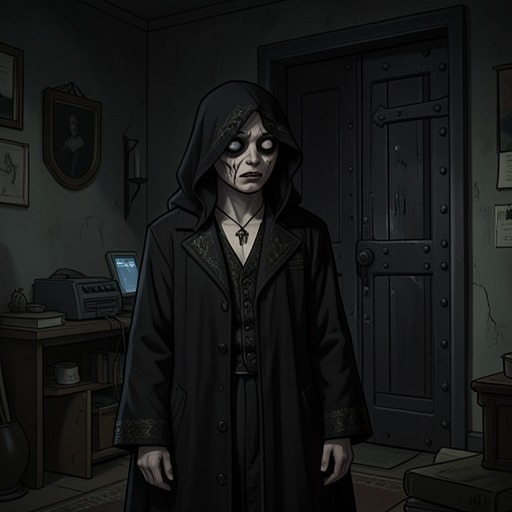
Human Blood Vessel
Living with 7 vampiresHuman Blood Vessel is the term used to define Y/N’s place among the vampires: not as a guest, daughter, or autonomous person, but as a living supply of blood. The designation exposes the castle’s central violence, because Y/N is a sixteen-year-old girl who is first interpreted through the needs and appetites of the supernatural beings around her. Her struggle is therefore not only to survive their feeding, but to reclaim the body, history, and power that the label attempts to reduce to a function.
Definition and First Use
At Y/N’s first encounter with the vampires, Jin presents her to the others as someone new to be hunted. Another voice repeats the word “prey,” and Y/N immediately recognizes that the household’s apparent interest in her may be predatory rather than protective. The language places her outside the category of a person deserving hospitality: she is identified according to what can be taken from her.
The term becomes explicit when V asks who is the only blood vessel in the house. Y/N rejects the classification, insisting that she is not a blood vessel. V answers that her only use there is as a blood vessel and tells her to accept it. His statement turns a description of her biology into a judgment of her value. The exchange also shows that the label is enforced socially: V does not merely hunger for blood, but claims the authority to decide what Y/N is good for.
The Body as Resource
The danger behind the terminology is confirmed when one of the vampires drinks Y/N’s blood. He presses his lips to her collarbone, causes a sharp pain, and feeds while she cries and screams with his hand over her mouth. The scene makes “Human Blood Vessel” a bodily condition produced through coercion. Y/N is not participating in a reciprocal exchange; her blood is taken while her speech and movement are suppressed.
The episode also transforms the word “prey” from an ominous introduction into a material reality. The vampire’s feeding demonstrates that the castle’s vocabulary is backed by physical power, and that the human body is treated as an accessible resource. Y/N’s fear is intensified by the fact that she had believed she could trust the person who attacks her. Trust and nourishment consequently become opposing forces: the appearance of shelter conceals an arrangement in which her survival depends on people who may also consume her.
Contesting Ownership and Protection
The status of Human Blood Vessel creates conflict among the vampires themselves. Jungkook objects that Y/N is being allowed to starve and challenges RM over the decision to keep her confined. He asks why RM is permitted to feed from her while the others are not, exposing the unequal distribution of access to Y/N’s blood. RM answers that she came to them because she was lost and no longer had a home, presenting her arrival as a reason for protection rather than possession.
Jungkook rejects that justification, arguing that the proper response would be to search for Y/N’s parents instead of keeping her in the castle. His objection is important because it identifies the contradiction at the heart of the role. If Y/N is a lost child, she requires care and help; if she is a blood vessel, she can be confined and consumed. The argument does not immediately free her from danger, but it prevents the label from becoming an uncontested description of her identity. Protection remains entangled with control, while hunger competes with the possibility that Y/N has rights beyond the castle.
Blood, Identity, and Memory
Y/N’s resistance to being called a blood vessel develops alongside her discovery that the family history she has been given is false or incomplete. She opens a locked book with a key and reads a diary entry stating that the name Y/N was chosen for her and that the writer could not leave the child outside in the cold. Y/N understands this as evidence that the woman she considered her mother may not be her biological mother, and she asks who her real parents are and why they abandoned her.
This discovery changes the meaning of her blood. At first, blood is treated as a consumable substance that establishes her usefulness to the vampires. Later, it becomes connected to descent, abandonment, and the question of who she is. The diary acts as a witness where the people around her have withheld or controlled information. Her body is not merely a container for nourishment; it is also the site through which questions of inheritance and supernatural power emerge.
Memory is repeatedly shown to be vulnerable to external control. Jin explains that he sacrificed his power to imprison other beings in a mirror and used what remained of that power to make the wounded vampires forget that the other people had ever existed. Later, after Y/N is brought back to her room and the surrounding space turns white, the narrative again presents a sudden rupture in perception and continuity. Assiah ultimately tells Jimin, Suga, and J-Hope that she erased Y/N’s memory. These acts of concealment parallel the blood-vessel label: both reduce Y/N’s authority over herself, one by controlling her body and the other by controlling the past she can know.
From Vessel to Agent
Y/N eventually faces a choice between pursuing the truth about her parents and saving the people connected to the mirrors. She decides that saving them matters more than knowing who or what her parents are, and points toward the bubble holding them. The decision marks a shift in value. Earlier, others decide what her body is for; here, Y/N chooses what her power and action will serve.
That shift becomes unmistakable during her confrontation with Gehan. After speaking of having had a conversation with herself, Y/N feels stronger and breaks a chain simply by moving her right arm. She then confronts Gehan over his fear of his own daughter, reversing the hierarchy that had allowed him to control or define her. When Y/N rises above the ground, her mother warns that she cannot control the power. Y/N answers by asking whether her mother intends to take the power away and make it her own, comparing her mother with her father. The moment does not erase the danger of uncontrolled power, but it demonstrates that Y/N is no longer merely an object acted upon by vampires, parents, mirrors, or memory magic.
Human Blood Vessel therefore describes an imposed condition rather than Y/N’s final identity. The label begins with predation, becomes a justification for unequal access to her body, and persists alongside efforts to hide her history. Against it, Y/N develops a competing definition of herself through refusal, moral choice, recovered questions, and direct use of power. The concept’s narrative significance lies in that reversal: a girl treated as a source of blood becomes the person who decides whether her strength will be used to rescue, resist, or confront those who claim authority over her.